Hawai‘i’s state bird, the nēnē, faces a rising threat from toxoplasmosis — a cat-borne disease also harming monk seals, dolphins, and more. Pacific Birds' Hawai'i Conservation Coordinator, Helen Raine, and Thierry Work of the U.S. Geological Survey (USGS) appear on KITV to explain how toxoplasmosis is threatening native wildlife, and what we can all do to help protect Nēnē, other wildlife, and ourselves.
Toxoplasmosis rates are rising in nēnē. This disease also has implications for human fertility rates. Watch the video above and keep reading to learn more.
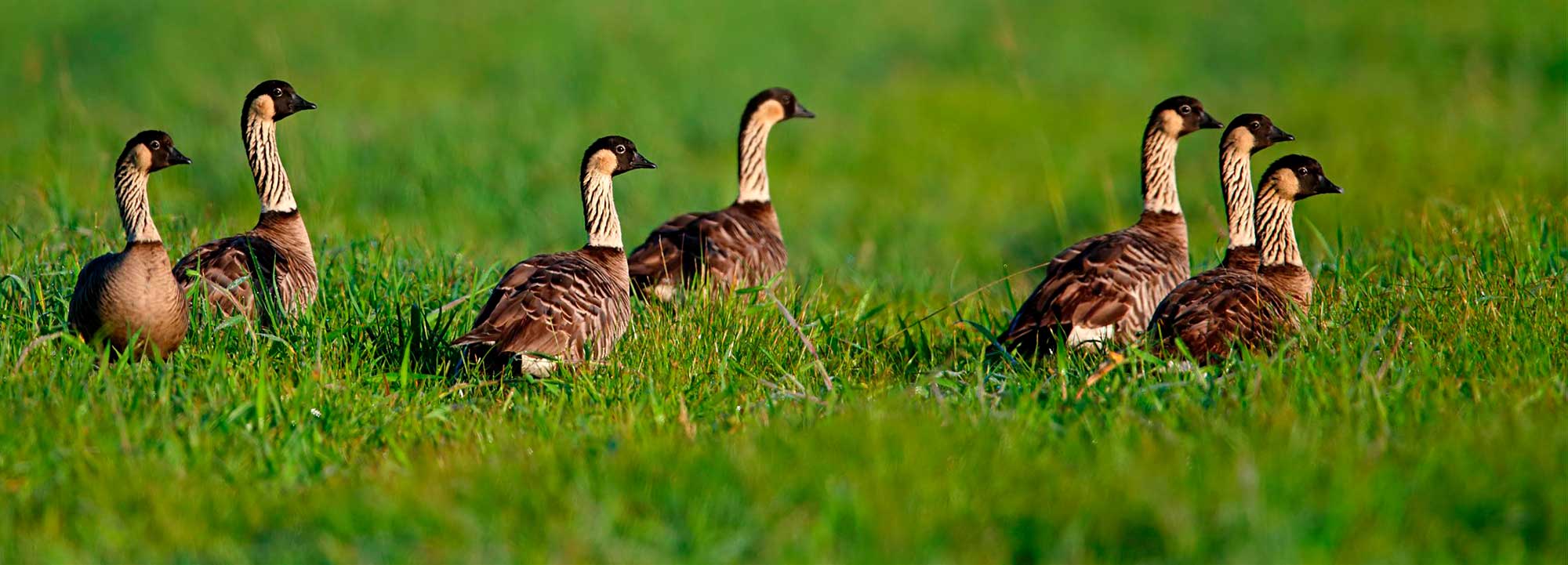
It is common knowledge that free-roaming and feral cats kill birds – many of us have seen it firsthand. What you may not realize is that cats also kill nēnē by passing on a disease called toxoplasmosis. And while nēnē may seem common on the North Shore of Kauaʻi and a few other locations in Hawaiʻi, they are on the Endangered Species list because there are less than 4,000 individual wild birds in the world.
Nēnē are unique to Hawaiʻi and are real survivors. At least seven distinct geese species evolved here. One was blind and burrowed underground like a mole; most were large and flightless; yet all of them went extinct except the feisty nēnē. The nēnē retained its ability to fly and developed a sassy personality to go with it. Their unusual neck patterning makes them stand out, and they have become an iconic symbol of Hawaiʻi as the State bird.
Yet, they are vulnerable to predation by cats, particularly their goslings. And equally troubling, as outdoor cat feeding has increased in Hawaiʻi, rates of toxoplasmosis in nēnē have rocketed, leading to additional bird deaths. The U.S. Geological Survey National Wildlife Health Center has a record number of cases already this year.
Nēnē get infected through contact with the feces of infected cats. That same feces also makes its way into wetlands and waterways – the same waterways, rivers and oceans that we swim in and share with other native species such as ʻilio holo i ka uaua (Hawaiian monk seal) and naiʻa (Hawaiian spinner dolphin), which are also affected by the disease.
Toxoplasmosis can be deadly to humans, causing miscarriage and birth defects in pregnant women, and sickness in people with compromised immune systems. Recent research also suggests that it affects male fertility, with a 2025 study showing that human sperm are decapitated when they come into contact with the parasite. The nēnē are our canary in the coal mine – they tell us that levels of toxoplasmosis in the environment are too high.
Cats are the primary host of the parasite Toxoplasma gondii, which is responsible for the toxoplasmosis infection, and the only source of oocysts (parasite eggs), which they pass on in their feces. A single cat can excrete hundreds of millions of infectious oocysts, and just one oocyst is sufficient to infect people and other animals. The occurrence of toxoplasmosis is directly linked to the high numbers of outdoor cats in Hawaiʻi.
There are things we can all do to reduce the likelihood of toxoplasmosis infection for people, birds, and other wildlife: stop outdoor cat feeding stations across the islands and encourage responsible pet owners to keep their cats indoors. Doing so will protect the unique wildlife that Hawaiʻi is famous for and keep our ohana (families) safe, too.
Got questions? We have answers:
With thanks to the National Oceanic and Atmospheric Administration (NOAA) and Kauaʻi Wildlife Coalition. NOAA has also produced this infographic.