Leveraging eBird Status and Trends to Inform Regional Conservation

A new study published in the journal Ornithological Applications shows how conservation organizations are using data from birdwatchers to pinpoint opportunities to reverse population declines.
The study, led by researchers from nine different Migratory Bird Joint Ventures, presents case studies demonstrating how data from birdwatchers can be used to select priority species, manage habitat for waterfowl, identify important bird areas, and monitor populations at regional scales.
The study used data from eBird, a participatory science project run by the Cornell Lab of Ornithology, which collects billions of observations from birdwatchers around the world into a centralized database.
"eBird data products help fill important data gaps and have been instrumental in supporting conservation planning across many Joint Ventures."
- Dr. Laura Farwell, Conservation and Science Coordinator at Pacific Birds Habitat Joint Venture
For coastal bird conservation, Pacific Birds Habitat Joint Venture used eBird data to quantify regional stewardship responsibility, discovering that 99% of the Marbled Murrelet population occurs within their continental region (Alaska, British Columbia, Washington, Oregon, and northern California) year-round. This information helps reinforce the area's importance for a federally listed species. eBird data also highlighted several species (like Long-billed Dowitcher and Short-billed Gull) that are found in high numbers within the region that were previously overlooked.
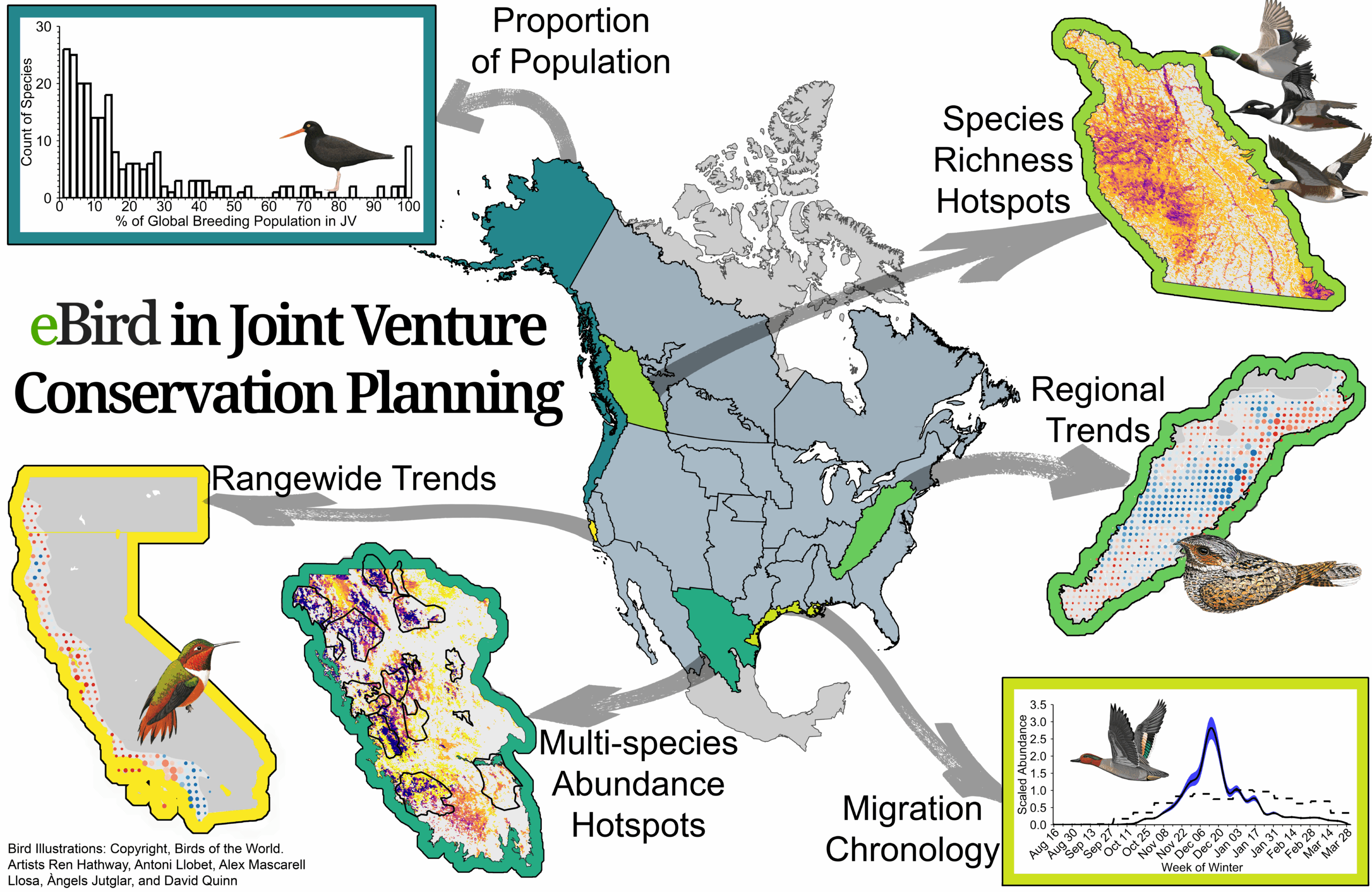
The research also addresses a persistent challenge in bird conservation: the lack of comprehensive, up-to-date information on where birds occur, how abundant they are, and how their populations change over time. Traditional monitoring programs are often constrained by funding and resources to conduct surveys throughout the year across regions of interest, limiting the ability of land managers to make informed decisions about where and when to focus limited resources.
The research demonstrates how freely available data can complement traditional monitoring programs to support more effective, targeted conservation planning. Joint Ventures now use these tools to coordinate planning across political boundaries and engage partners with compelling, evidence-based cases for conservation action.
“Data may not be the solution to all conservation challenges, but the absence of it has long been one of the greatest barriers to progress. For too long, conservation decisions have been constrained by the lack of timely, comprehensive information. Now, through collaboration between conservation organizations and academic institutions, and the integration of participatory science, we have the ability to close some of those critical gaps.”
- Dr. Jenny Muñoz, Science Coordinator for Canadian Intermountain Joint Venture and Pacific Birds-Canada
Citation:
Farwell, L. S., A. N. Stillman, J. D. Lancaster, S. P. Turbek, J. M. Muñoz, A. M. Peele, R. J. Rylander, G. M. Yanega, M. N. Iglecia, O. J. Robinson, A. M. Duren, A. Hannuksela, A. Huang, G. S. Yarris, and C. G. Eger (2025). Leveraging eBird data products to inform regional bird conservation priorities and objectives. Ornithological Applications 128:duaf000. doi.org/10.1093/ornithapp/duaf074